
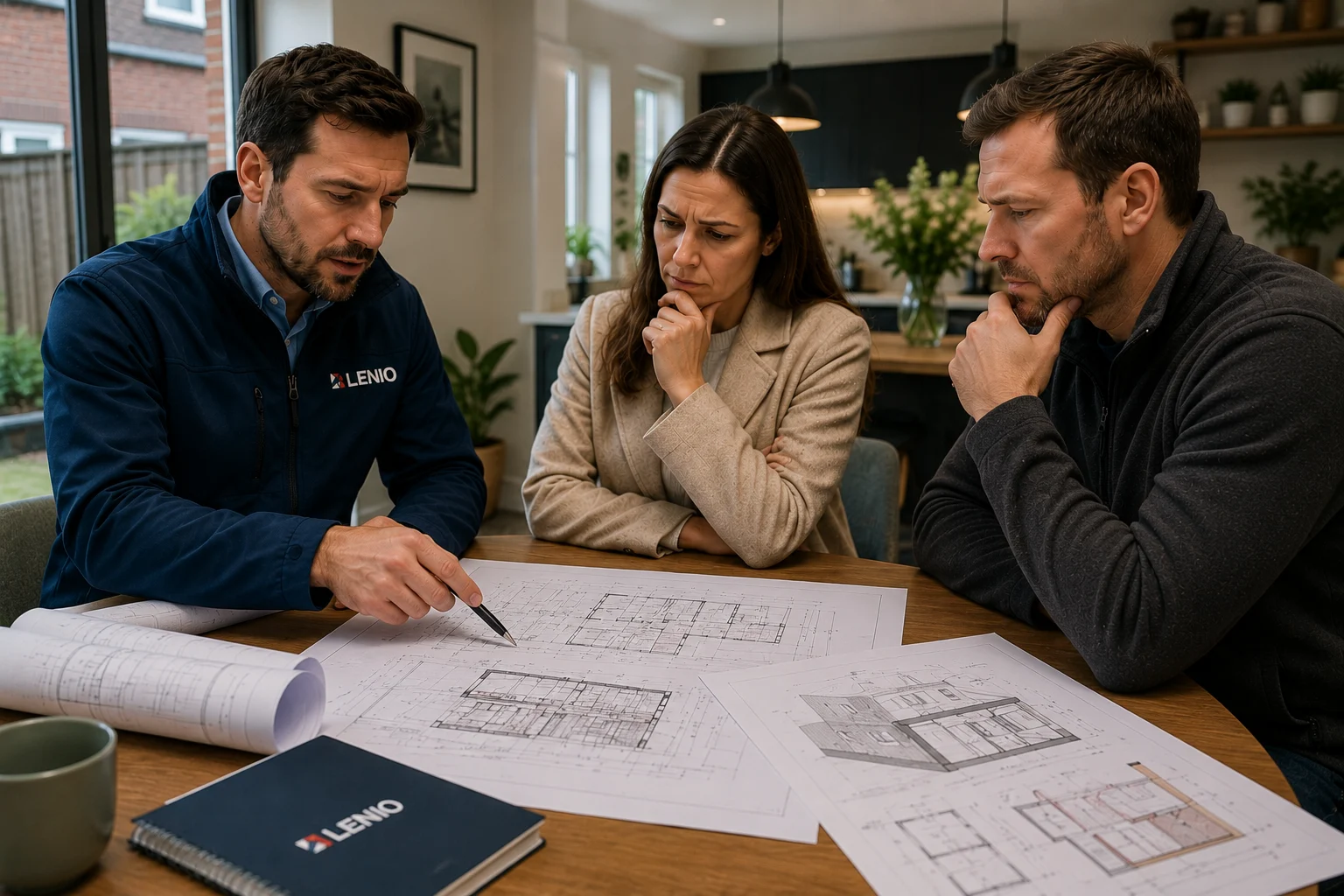
In a party wall notice vs award comparison, the key difference is one of timing and purpose. The notice is the formal letter you serve before works begin, and the award is the legal document that follows only if your neighbour dissents.
Understanding the party wall notice vs award distinction is one of the most common points of confusion for London homeowners. The two terms sound similar, but they happen at different stages and do different jobs.
This guide explains the difference between a party wall notice and award. It covers what each one is, how they differ, and how a notice can lead to an award. By the end, you will know which one applies to your situation.
A Party Wall Notice is the formal written notification you serve on your neighbour before starting certain building works. It tells them what you plan to do and when. Serving it is a legal requirement under the Party Wall etc. Act 1996 for notifiable works.
You serve a notice as the Building Owner, the person carrying out the works. It is the first formal step in the party wall process. The works it covers include extensions, loft conversions, basement digs and other work affecting a shared wall or a neighbour’s foundations.
A notice does not, by itself, mean there is a dispute. In many cases the neighbour consents, and no further document is needed.
A Party Wall Award is a legal document prepared by surveyors. It sets out how and when the works are carried out, and how the neighbouring property is protected. Unlike a notice, an award is only needed if a dispute arises.
A dispute is deemed to arise when your neighbour dissents to the notice, or does not respond within 14 days. At that point, surveyors are appointed and the award follows. It is binding on both owners.
So an award is not a starting point. It is a later stage that only some projects reach, depending on how the neighbour responds.
The clearest way to see the difference between a party wall notice and award is side by side. The table below compares the two across the points that matter most.
| Party Wall Notice | Party Wall Award | |
|---|---|---|
| What it is | A formal notification of works | A legal document setting out terms |
| Who produces it | The Building Owner serves it | Surveyors prepare it |
| When it happens | Before works begin | Only after a dissent or no response |
| What it does | Tells the neighbour what is planned | Sets out how the works proceed |
| Always needed? | Yes, for notifiable works | No, only if a dispute arises |
Both routes end in the same place: a Party Wall Award. The Building Owner usually pays the reasonable fees in either case. Our guide on the agreed surveyor versus two surveyors covers this choice in full.
A notice and an award are two points on the same path. What happens in between depends entirely on how your neighbour responds.
You serve the notice on every affected neighbour before works begin.
The neighbour has 14 days to consent or dissent in writing.
If they consent, no award is needed and the works can proceed.
If they dissent, or say nothing, a dispute is deemed to arise.
Under section 10, surveyors are appointed to resolve it.
The Award is agreed and served, and then the works can begin.
The off-ramp at step 3 is the one most projects take. A dissent simply sends the project along the longer route to an award.
No. You do not always need a Party Wall Award. You only need one if your neighbour dissents to the notice, or does not respond within the 14-day period.
If your neighbour consents in writing, the works can proceed on the notice alone. A Schedule of Condition is still worth arranging, but no award is required. This is the simplest and most common outcome on straightforward projects.
So a notice is always required for notifiable works, but an award is not. Whether you reach the award stage is decided by your neighbour’s response, not by you.
Where you are in the process tells you which document you are dealing with.
You are at the notice stage. Your first step is to serve the correct Party Wall Notice before works begin. A party wall surveyor confirms which notices apply and serves them for you.
You are heading toward an award. Surveyors are appointed to prepare it, and the works wait until it is in place.
LENIO Party Wall Surveyors provides free initial advice to Building Owners and Adjoining Owners across London. Tell us where you are in the process and a chartered surveyor will explain your next step.
LENIO Party Wall Surveyors has more than 5+ years of party wall practice across London. A chartered surveyor leads every instruction personally. Dissents and Party Wall Awards are a routine part of the practice’s work. These range from single-surveyor appointments on straightforward extensions to two-surveyor disputes on basement and structural projects.
LENIO specialises entirely in party wall matters. Every guide on this site is written from direct professional experience of the process, not from secondary research.
In everyday language, yes. People often call the Award a party wall agreement. Strictly, the legal document prepared by surveyors is the Party Wall Award, and the notice is a separate, earlier step.
So if someone mentions a party wall agreement, they usually mean the Award that follows a dissent. The notice is what starts the process before any agreement is reached.
No. The notice always comes first. An award can only arise once a notice has been served and a dispute has been deemed to arise.
Serving a valid notice is what starts the process. Without it, there is nothing for an award to resolve, and no basis for appointing surveyors.
No. Written consent means the works can proceed on the notice alone, with no award required. A Schedule of Condition is still recommended to protect both sides.
The award stage is only reached if a neighbour dissents or fails to respond within 14 days. Consent keeps your project on the simpler, quicker route.
Yes. Once served, the Award is legally binding on both the Building Owner and the Adjoining Owner. Either party can appeal it to the county court within 14 days.
A Party Wall Notice, by contrast, is a formal notification rather than a binding agreement. It sets the process in motion, but it does not fix the terms of the works.
The notice stage is far cheaper, and it is often the only cost if your neighbour consents. The award stage adds surveyor fees for preparing the document.
The Building Owner usually pays the reasonable fees at both stages. Our guide on party wall surveyor costs explains what affects the figure.
Only if you dissent, or do not respond within 14 days. If you consent in writing, no award is prepared and the works proceed on the notice alone.
If you have concerns, dissenting is not hostile. It simply leads to an Award that protects your property in writing, which is your right under the Act.
A chartered surveyor leads every instruction at LENIO Party Wall Surveyors personally. With more than 5+ years of party wall practice across London, LENIO provides free initial advice before any commitment is made.