
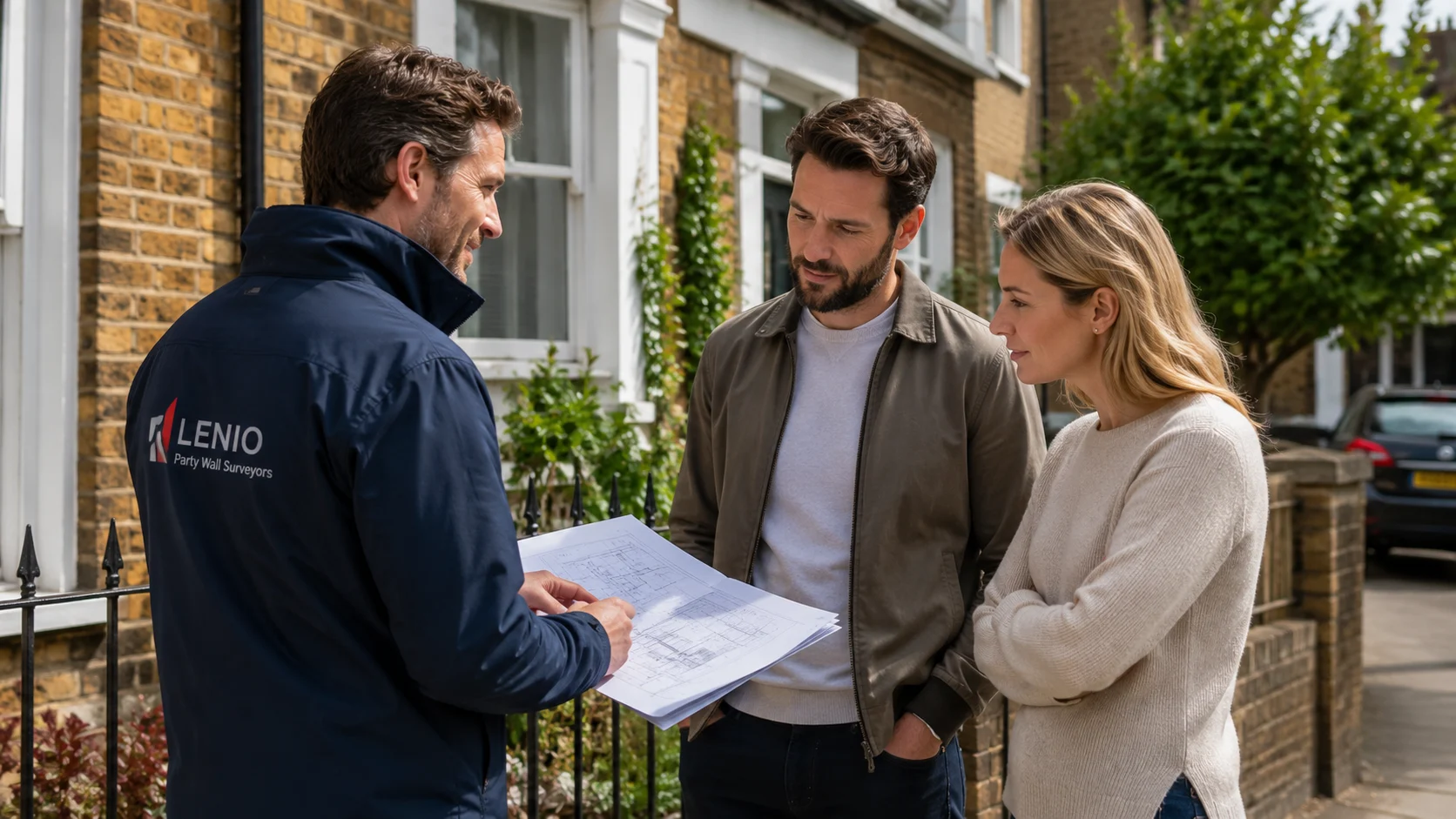
In an agreed surveyor vs two surveyors decision, the difference is simple: one impartial surveyor acts for both owners, or each owner appoints their own. The Agreed Surveyor route is usually cheaper and faster, while two surveyors give each side their own representation.
Once a neighbour dissents to a party wall notice, surveyors are appointed, and you face a choice: agreed surveyor vs two surveyors. It is one of the few cost decisions you actually control in the process.
This guide explains both routes, what each costs in time and money, and how to choose the one that fits your situation.
The difference is the number of surveyors, not the level of protection. Both routes follow the same Act, reach the same kind of Party Wall Award, and protect both owners. What changes is cost, speed and representation.
With an Agreed Surveyor, both owners appoint a single, impartial surveyor who acts fairly for both. With two surveyors, each owner appoints their own, and the two work together to agree the Award.
Neither route is better in the abstract. The right one depends on how comfortable both sides are with a single appointment. The rest of this guide helps you judge that.
So what is an Agreed Surveyor? It is one surveyor appointed jointly by both owners to resolve the party wall matter. The role is impartial. The surveyor does not act for the Building Owner or the Adjoining Owner, but settles how the works proceed fairly for both.
Because there is one appointment, there is one set of fees and one line of communication. That is why the agreed surveyor party wall route is usually the quicker and cheaper of the two.
It depends on trust. Both owners have to be comfortable that a single surveyor will treat them fairly, which is common where the relationship between neighbours is reasonable.
In the two-surveyor route, each owner appoints their own surveyor. The Building Owner has one, the Adjoining Owner has another, and the two work together to agree the Award. They also select a Third Surveyor at the outset, who only steps in if they cannot agree.
This route gives each owner their own representative looking solely at their interests. For some Adjoining Owners, especially on larger or sensitive projects, that reassurance is worth the extra cost.
It does cost more, because there are two sets of fees, usually both met by the Building Owner. The two-surveyor route can also take a little longer, since two surveyors must align rather than one acting alone.
The agreed surveyor vs two surveyors choice comes down to a handful of practical differences. The table sets them out.
| Agreed Surveyor | Two Surveyors | |
|---|---|---|
| Number of surveyors | One, for both owners | One each |
| Cost | Lower · one fee | Higher · two fees |
| Speed | Usually faster | A little longer |
| Representation | Impartial, for both | Each owner has their own |
| Third Surveyor | Not appointed | Selected at the outset |
| Best where | Neighbours on reasonable terms | Either side wants their own |
Both routes end in a binding Party Wall Award. The protection is the same. Only the path to it differs.
Use this as a quick guide. Most London projects fit one side or the other clearly.
cheaper · faster
own representation
Yes, to a degree. If you start with an Agreed Surveyor and one owner later loses confidence, that owner can appoint their own surveyor. That moves you onto the two-surveyor route. The reverse is harder once two are appointed.
Switching adds cost and time, so it is worth getting the choice right at the start. In practice, most projects that begin with an Agreed Surveyor stay with one.
If you are unsure which route suits your project, a short conversation usually settles it before any appointment is made.
Yes. Whichever route you take, the Act requires a party wall surveyor to prepare the Party Wall Award once a dispute is deemed to have arisen. The works cannot proceed without it.
The question is not whether to use a party wall surveyor, but how many. LENIO acts as the Agreed Surveyor for both owners where they are comfortable with one appointment. Where two are preferred, LENIO acts as the Building Owner’s or Adjoining Owner’s surveyor.
A chartered surveyor leads every appointment at LENIO personally, a Chartered Civil Engineer with 5+ years of party wall practice across London.
LENIO Party Wall Surveyors provides free initial advice to Building Owners and Adjoining Owners across London. Tell us about your project and a chartered surveyor will explain which route fits.
LENIO Party Wall Surveyors has 5+ years of party wall practice across London. A chartered surveyor leads every instruction personally. Dissents and Party Wall Awards are a routine part of the practice’s work. These range from single-surveyor appointments on straightforward extensions to two-surveyor disputes on basement and structural projects.
LENIO specialises entirely in party wall matters. Every guide on this site is written from direct professional experience of the process, not from secondary research.
No. An Agreed Surveyor is impartial by law and acts fairly for both owners, not for the party who suggested them. Their duty is to the correct application of the Act, not to either side.
This is the point that reassures most Adjoining Owners. The surveyor cannot favour the Building Owner, even though the Building Owner usually pays the fee.
Yes. Every owner has the right to appoint their own surveyor, which moves the matter onto the two-surveyor route. You cannot require a neighbour to accept an Agreed Surveyor.
If they prefer their own, that is their right, and the process still works smoothly. The two surveyors simply agree the Award between them.
In almost all cases, yes, because one appointment means one set of fees rather than two. The agreed surveyor party wall route is usually faster as well, since one surveyor acts alone.
The exception is rare: a project where a single surveyor takes far longer than two working in parallel. For most London projects, the Agreed Surveyor route is the cheaper choice.
An owner who loses confidence in the Agreed Surveyor can appoint their own surveyor instead. That moves the matter onto the two-surveyor route, with a Third Surveyor available if needed.
This is uncommon, because an Agreed Surveyor is chosen jointly at the outset. The option exists as a safeguard rather than a likely outcome.
Yes, fully. The Agreed Surveyor must protect the Adjoining Owner’s property just as a separately appointed surveyor would. That includes a Schedule of Condition and clear conditions in the Award.
Impartial does not mean weaker. The same protections apply, prepared by one surveyor instead of two.
No. A Third Surveyor is only selected where two surveyors are appointed, as a backstop if they disagree. With a single Agreed Surveyor, there is no one to disagree with, so no Third Surveyor is needed.
This is part of why the route is simpler and quicker. One appointment removes a whole layer of the process.
A chartered surveyor leads every appointment at LENIO Party Wall Surveyors personally. With 5+ years of party wall practice across London, LENIO provides free initial advice before any commitment is made.