
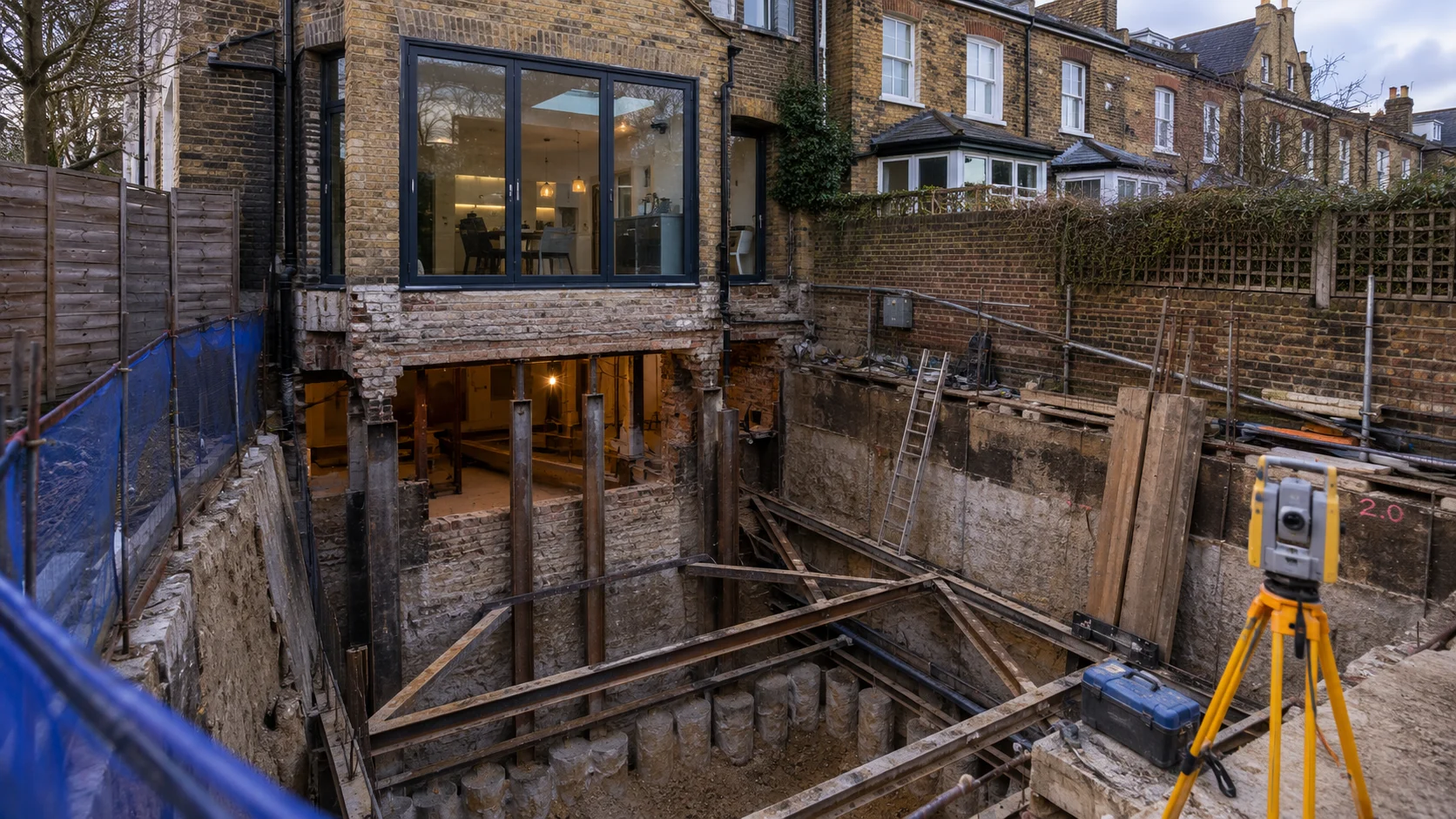
A basement is the most party-wall-intensive project a London homeowner can take on. So if you are planning one, a party wall notice for basement excavation is almost certainly part of it.
This guide explains why basements trigger the Act and how the 3 metre and 6 metre rules work. It covers which notices apply and the extra protections a basement Award includes.
In almost all cases, yes. A basement excavation digs below and close to neighbouring foundations, which is exactly what the Party Wall etc. Act 1996 is designed to govern. A party wall notice for basement excavation is needed on nearly every London basement.
The exceptions are rare. A basement set well away from every neighbour, in a large detached plot, might avoid the excavation rules. In London’s terraced and semi-detached streets, that is almost unheard of.
So the real question is not whether you need a notice, but which notices, and that depends on the design. If you are asking do I need a party wall notice for a basement, treat the answer as yes and plan from there.
Two features of a basement bring the Act into play, and most basements have both.
First, depth. A basement is dug deeper than the neighbour’s foundations by definition, which is the test the excavation rules apply. Second, proximity. London basements sit within metres of the neighbouring structure, often directly beneath the party wall.
Add underpinning, which most basements need to support the existing structure, and the works also become work to the party wall itself. That is two triggers from a single project. It is why a party wall notice for basement excavation usually involves more than one notice.
The excavation rules under section 6 are where most basement notices come from. They are measured from the neighbour’s structure, and a basement usually falls inside both.
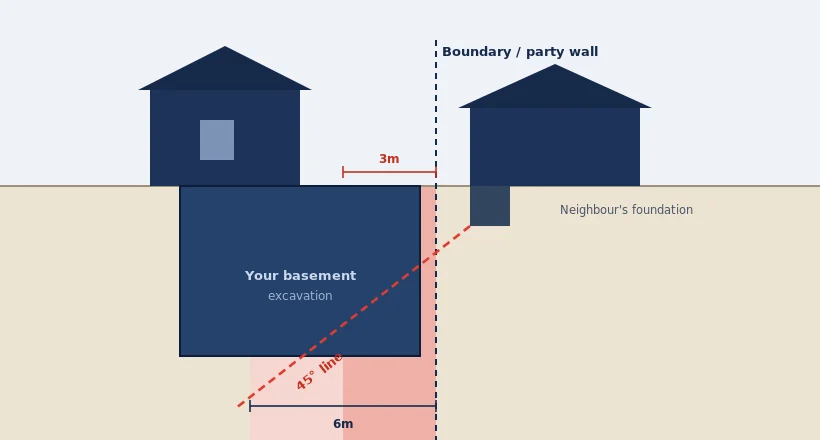
The 3 metre rule. A notice is required if you excavate within 3 metres of a neighbouring building and deeper than its foundations. A basement always digs deeper, so any neighbour within 3 metres must be notified.
The 6 metre rule. A notice is also required within 6 metres, where a 45-degree line drawn down from the bottom of the neighbour’s foundations meets your excavation. Deep basements reach this line easily, which is why the 6 metre rule catches projects that look further away.
The diagram shows both zones. In practice, a London basement is almost always inside the 3 metre rule for at least one neighbour.
A basement commonly needs more than one notice, because it does more than one thing. The excavation needs a section 6 notice, the underpinning needs a Party Structure Notice, and a new boundary wall needs a section 1 notice. The table sets out the usual combination.
| Element of the basement | Notice | Section |
|---|---|---|
| Excavation near neighbouring foundations | Excavation Notice | Section 6 |
| Underpinning or work to the party wall | Party Structure Notice | Section 3 |
| New retaining wall at the boundary | Line of Junction Notice | Section 1 |
A party wall notice for basement excavation almost never comes alone. A party wall surveyor reviews the structural design and confirms the full set before any notice is served. On a basement, getting this combination right matters more than on any other project. A missed section 6 notice, in particular, can stop the dig.
Most basements underpin the existing walls, including the party wall, to support the structure while the ground below is removed. Underpinning the party wall is work to a party structure, served under a Party Structure Notice.
This is why a basement is rarely a section 6 only job. The excavation triggers section 6, and the underpinning triggers the party wall provisions at the same time.
Because underpinning carries real structural risk, the Award for a basement goes further than for a simpler project. It controls how the work is done, not just whether it can.
A basement Award is more detailed than most, and that detail is there to protect both properties. It typically sets out:
The surveyors agree these conditions before works begin. On a basement, the Award is as much about how the works are controlled as whether they go ahead.
Yes, and a basement is not the project to handle without one. A basement party wall surveyor confirms the full set of notices, serves them correctly, and agrees an Award that controls the structural risk.
Because basements carry higher risk, neighbours more often appoint their own surveyor, so the two-surveyor route is common. The Building Owner usually meets both sets of reasonable fees.
A chartered surveyor leads every basement instruction at LENIO personally. As a Chartered Civil Engineer, the surveyor understands the structural method as well as the party wall process, which matters on a basement appointment.
LENIO Party Wall Surveyors handles basement party wall matters across London. Send your structural drawings and a chartered surveyor will confirm which notices apply and what the Award will cover.
LENIO Party Wall Surveyors has 5+ years of party wall practice across London. A chartered surveyor leads every instruction personally. Dissents and Party Wall Awards are a routine part of the practice’s work. These range from single-surveyor appointments on straightforward extensions to two-surveyor disputes on basement and structural projects.
LENIO specialises entirely in party wall matters. Every guide on this site is written from direct professional experience of the process, not from secondary research.
In London, very nearly every one does. A basement digs deeper than the neighbour’s foundations and within metres of their structure, which triggers the excavation rules on almost every site.
The rare exception is a basement far from any neighbour on a large plot. In terraced and semi-detached streets, a notice is effectively certain.
Underpinning extends the existing foundations downward so the structure stays supported while the basement is dug below. Most basements underpin the party wall itself.
Because that is work to a party structure, it needs a Party Structure Notice as well as the excavation notice. This is why basements usually involve more than one notice.
Basements carry more structural risk than most projects, so Adjoining Owners more often want their own surveyor watching their interests. That makes the two-surveyor route common on basements.
The Building Owner usually pays both sets of reasonable fees. Our guide on agreed surveyor versus two surveyors explains the choice in full.
Movement monitoring means measuring the neighbouring property during the dig to confirm it is not moving beyond agreed limits. The Award sets the limits and the method.
If movement is detected, work pauses and the agreed procedure is followed. It is a safeguard that protects both owners, and it is standard on basement Awards.
A basement usually sits at the upper end of party wall costs, because it involves multiple notices, often two surveyors, and a detailed Award. It is the most involved project type.
The figure depends on the design and the number of neighbours. Our guide on party wall surveyor costs sets out the ranges and what drives them.
Allow longer than for a simpler project. The two-month notice period still applies, and the detailed Award a basement needs can take longer to agree than a standard one.
Serving notice early, once the structural design is settled, is the best way to protect your programme. Our guide on how long the party wall process takes covers the full timeline.
A chartered surveyor leads every basement instruction at LENIO Party Wall Surveyors personally. With 5+ years of party wall practice across London, LENIO provides free initial advice before any commitment is made.