

A party wall notice for extension works is required in most London projects, though the answer depends on the specific works involved. The Act applies when you build a wall at the boundary, excavate near a neighbour’s foundations, or cut into a shared party wall.
If you are planning an extension in London, a party wall notice for extension works is one of the first legal steps to get right. Most rear and side extensions in London’s terraced and semi-detached streets affect a boundary, a neighbour’s foundations or a shared wall.
This guide explains which extension works trigger the Party Wall etc. Act 1996. It covers which notice you need, how long the process takes and what happens once the notice is served.
In most London extensions, the answer is yes. A party wall notice for extension works is needed whenever the project affects a shared wall, the boundary, or a neighbour’s foundations. The answer depends on what your extension involves, and confirming it early is usually straightforward.
There is a simple reason extensions trigger the Act so often. Most London homes are terraced or semi-detached, so the next structure is rarely more than a few metres away. A rear or side extension usually digs new foundations close to that structure and builds near, or up to, the boundary. That proximity is what brings the Act into play.
It helps to separate two things that often get confused. Planning permission and the Party Wall etc. Act 1996 are different requirements. Permitted development rights or a planning approval tell you what you may build. They do not remove the duty to serve a notice where the works are notifiable. Both can apply to the same extension at the same time.
If your architect or structural engineer has already raised a party wall point, treat that as a strong sign the Act applies. The best time to confirm your position is before your start date is fixed. A notice served late, or not at all, can stall the project once works begin, and that is far harder to fix than checking early.
Not every part of an extension affects your neighbour. In most London projects, though, at least one element does. The works that commonly need a party wall notice for extension projects fall into three groups.
If you build a new wall along or astride the boundary with your neighbour, the Act applies. This is served as a Line of Junction Notice.
Extension foundations often sit within 3 or 6 metres of a neighbouring structure. Digging deeper than their foundations requires an excavation notice.
Where the extension cuts into, bonds to, or loads the shared wall, the Act applies. This is served as a Party Structure Notice.
Many rear extensions trigger more than one of these at once. A side return that digs new foundations and builds to the boundary, for example, can need two notices.
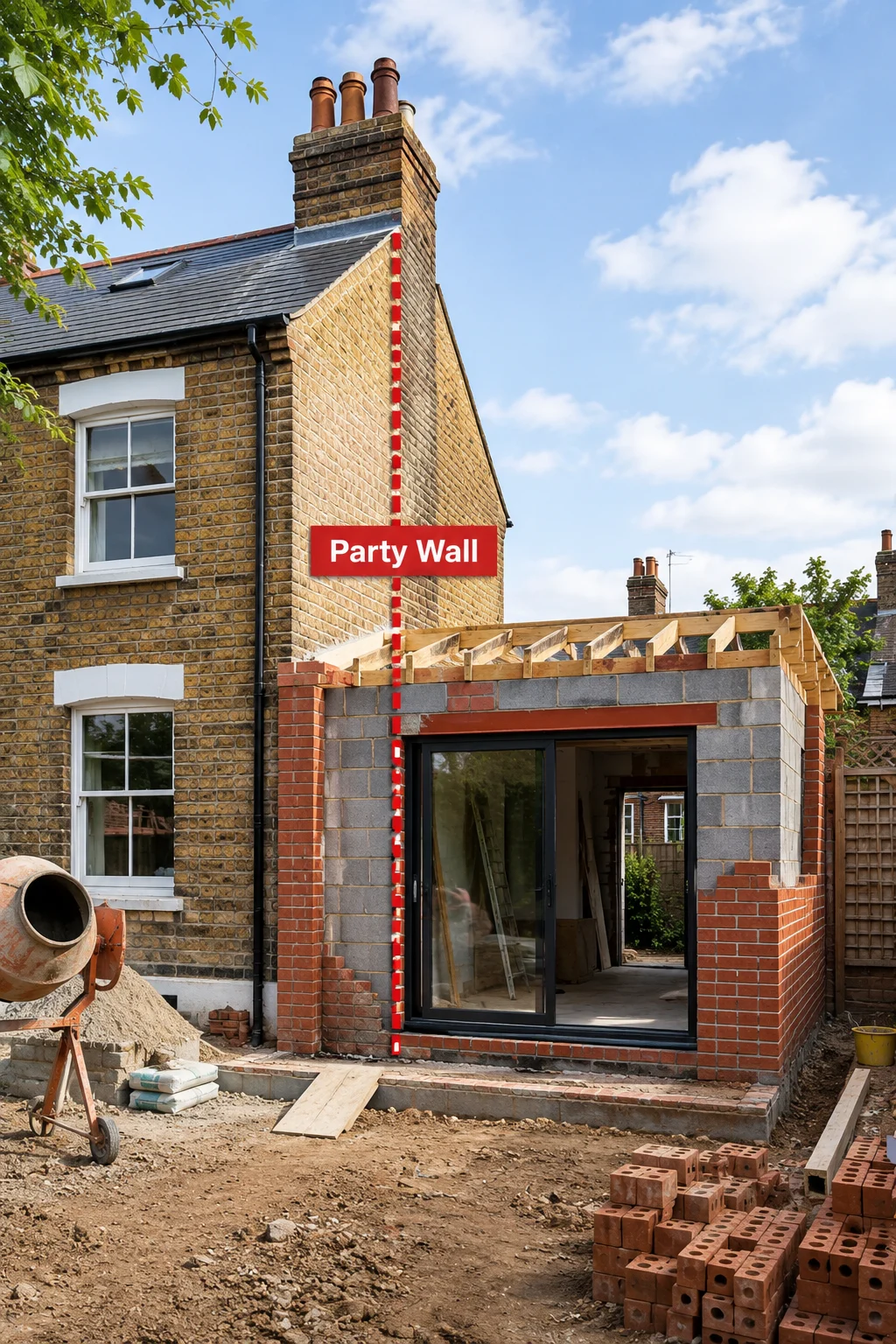
Extensions almost always need new foundations, and those foundations are what bring section 6 into play. The Act sets two distance rules, both measured from your neighbour’s structure. If your excavation falls inside either one, a notice is required.
The 3 metre rule
A notice is required if you excavate within 3 metres of a neighbouring building and go deeper than its foundations. Most extension foundations in London fall within this distance.
The 6 metre rule
A notice is also required if you excavate within 6 metres of a neighbouring building. It applies where a 45-degree line, drawn down from the bottom of their foundations, meets your excavation. This catches deeper digs, such as basements or piled foundations.
Both rules are measured from your neighbour’s structure, not from the boundary. Because London homes sit so close together, a standard rear extension often falls inside the 3 metre rule without the owner realising. Where it does, your project needs a section 6 excavation notice alongside any boundary or party wall notice.
The notice your extension needs depends on the work, not on the size of the project. A single extension can need one notice or several. The table below sets out the three notices that apply to extension works and the minimum notice period for each.
| Type of work | Notice | Minimum notice period |
|---|---|---|
| New wall at or astride the boundary | Line of Junction Notice (section 1) | 1 month |
| Cutting into or building off the party wall | Party Structure Notice (section 3) | 2 months |
| Excavating near a neighbour's foundations | Excavation Notice (section 6) | 1 month |
A rear extension that builds to the boundary and digs new foundations near next door is a common example. That project can need two notices. Each affected neighbour receives their own notice, and each notice runs its own period. A party wall surveyor reviews the full scope of works first, then confirms which notices apply before any are served.
The notice period depends on the type of work, and it runs from the date the notice is served, not from your planned start date. Party Structure works need two months. Boundary and excavation works need one month.
These are statutory minimums and cannot be shortened without the Adjoining Owner’s written agreement. So the party wall process needs a place in your project programme from the start, not once the contractor is booked.
A notice has a shelf life. A Party Wall Notice stays valid for 12 months from the date it is served. A notice served too early can expire before works begin, so LENIO generally recommends serving once the structural design and scope are settled.
The notice must also reach the correct owners, and in London that is not always a single neighbour. Qualifying owners can include:
This matters most with flats and converted houses, where one neighbouring property may have several owners who each need a notice.
Once the notice is served, the Adjoining Owner has 14 days to respond. There are three possible outcomes, and each leads to a clear next step.
The simplest is written consent. If your neighbour agrees in writing, the works can proceed without a Party Wall Award. Even then, a Schedule of Condition is worth arranging before works begin. It records the condition of the neighbouring property and protects both sides if a damage claim arises later.
If your neighbour dissents, a dispute is deemed to have arisen and surveyors are appointed under section 10. The surveyors prepare a Party Wall Award setting out how the works proceed, including access, working hours and protective measures. Works covered by the Award cannot begin until it is in place. In practice, the Award process is straightforward on most extensions and does not stop the project going ahead.
If your neighbour does not respond within 14 days, the Act treats the silence as a dispute. You must then serve a further request, giving them 10 days to appoint a surveyor. If they still do not, you can appoint one on their behalf and the process continues. Assuming that silence means consent is one of the most common and costly mistakes on extension projects.
You are not legally required to appoint a party wall surveyor for an extension. The Act lets a Building Owner prepare and serve notices themselves. In practice, most homeowners use a surveyor, because extensions often involve more than one notice and several affected owners.
A party wall surveyor for an extension in London confirms which notices apply and identifies every owner who must be served. The surveyor then serves each notice correctly and on time. Where a neighbour dissents, the surveyor prepares the Party Wall Award and carries out the Schedule of Condition. Getting this right from the start is what keeps an extension on programme.
A chartered surveyor leads LENIO’s extension instructions across London personally, a Chartered Civil Engineer with 5+ years of party wall practice in London’s terraced and semi-detached housing stock.
LENIO Party Wall Surveyors provides free initial advice to Building Owners across London. Send your drawings or project details and a chartered surveyor will confirm which notices apply and what the process involves.
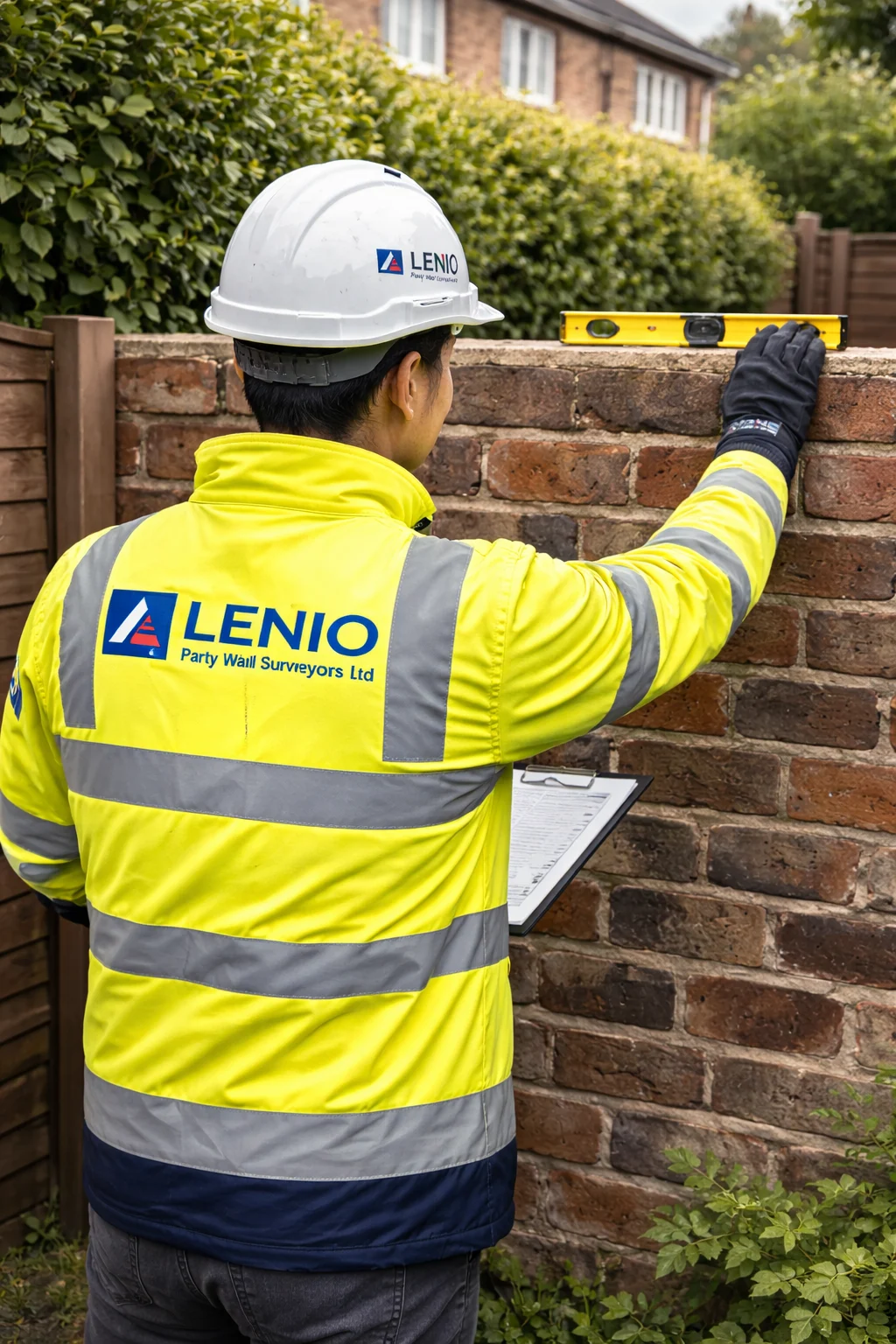
LENIO Party Wall Surveyors has 5+ years of party wall practice across London. A chartered surveyor leads every instruction personally. Dissents and Party Wall Awards are a routine part of the practice’s work. These range from single-surveyor appointments on straightforward extensions to two-surveyor disputes on basement and structural projects.
LENIO specialises entirely in party wall matters. Every guide on this site is written from direct professional experience of the process, not from secondary research.
Usually yes. A side return often builds a new flank wall at or near the boundary and excavates new foundations beside the neighbouring house. That commonly triggers a Line of Junction Notice, an excavation notice, or both.
The exact notices depend on where the new wall sits in relation to the boundary line. A party wall surveyor can confirm which apply once your drawings are available.
Not always, but in most London extensions it is. A notice may not be required if the works avoid three things: the boundary, a shared wall, and excavation near a neighbour’s foundations.
That combination is uncommon in London’s dense housing, where extensions usually sit close to at least one neighbour. Confirming the position early costs nothing and removes any risk of a delay later.
No. The statutory notice period must run in full before notifiable works begin, unless your neighbour agrees in writing to an earlier start. Starting early risks an injunction and undermines the protection the process gives both sides.
This is why the notice period needs to sit in your programme from the outset. Serving notice once the structural drawings are ready is the safest approach.
Yes. Every Adjoining Owner affected by the works is entitled to their own notice and their own response period. A mid-terrace extension can affect the neighbours on both sides, and each one must be served.
In flats or converted houses, more than one owner of a single neighbouring property may need a notice. Identifying every qualifying owner is part of what a surveyor confirms before serving.
Almost always. A two-storey or double extension usually cuts into the party wall at first-floor level and digs deeper foundations near the neighbouring property. Both are notifiable, so a Party Structure Notice and an excavation notice often apply together.
Double-storey work tends to involve more structural connection to the shared wall than a single-storey extension. A party wall surveyor confirms exactly which notices apply once the structural drawings are ready.
It depends on the scope of works, and on how many notices and neighbours are involved. A straightforward extension with a single notice costs less than one needing several notices or a Party Wall Award. Lenio gives a clear quote after reviewing your drawings, with no obligation.
Lenio does not use fixed prices that ignore the detail of a project. For a fuller breakdown of what affects the cost, see our guide on party wall surveyor fees. Initial advice on your extension is always free.
A chartered surveyor leads every extension instruction at LENIO Party Wall Surveyors personally. With 5+ years of party wall practice across London, LENIO provides free initial advice to Building Owners before any commitment is made.