
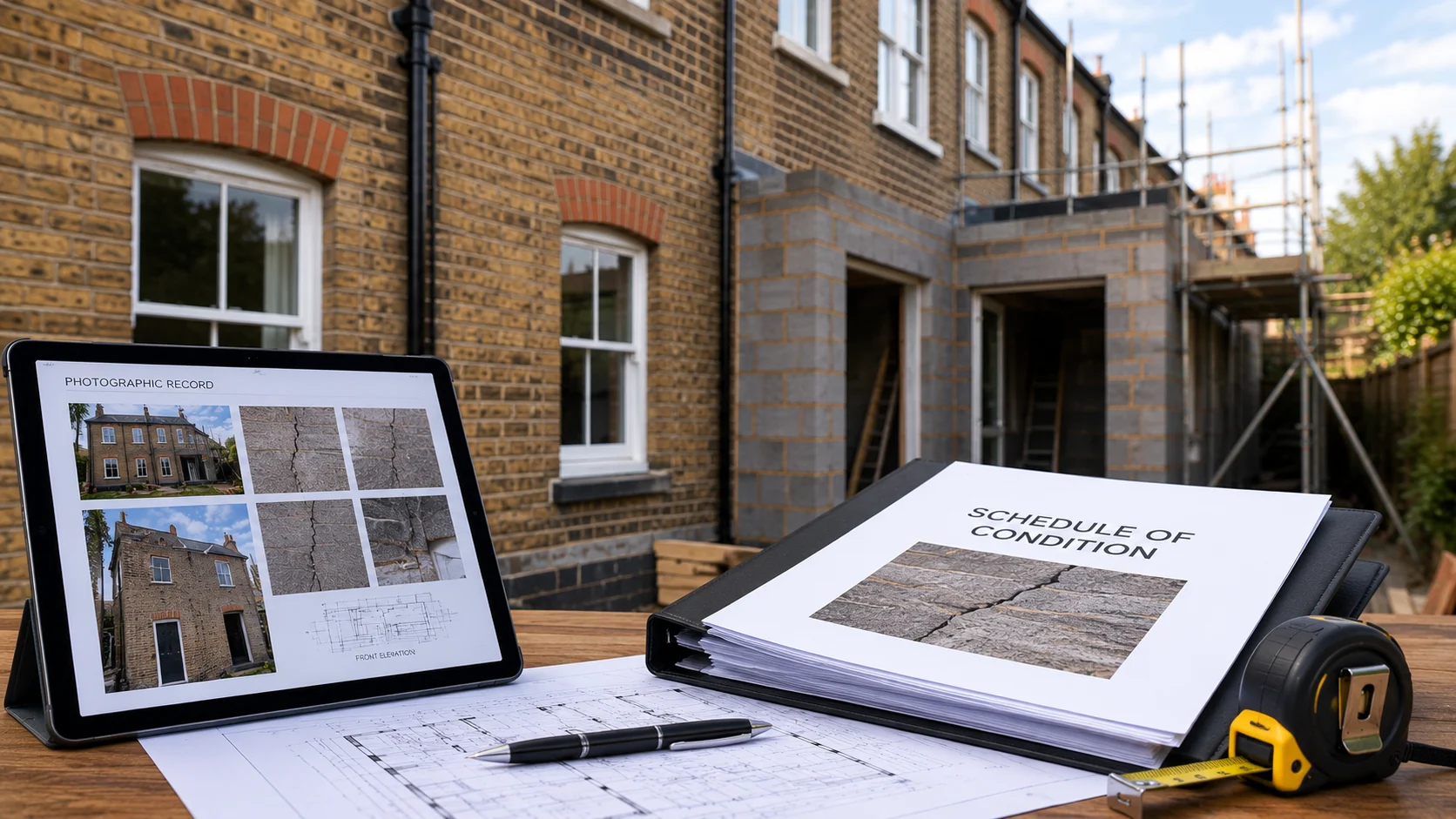
What is a schedule of condition? It is a written and photographic record of a neighbouring property’s state, taken before building works begin. If damage is alleged later, the record shows what existed beforehand, protecting both the Building Owner and the Adjoining Owner.
If a surveyor or architect has mentioned one, your first question is probably what is a schedule of condition, and whether your project needs it. The short answer: it is the simplest protection the party wall process offers.
This guide explains what the document records, when it is carried out, and who pays. It also shows how it protects you, whichever side of the wall you are on.
A Schedule of Condition is a factual record of a neighbouring property’s state before building works begin. A party wall surveyor prepares it, walking through the rooms closest to the works and recording what is there. The result is a dated document of notes and photographs.
It is not a building survey, and it makes no judgement about quality. It simply fixes the evidence: this crack existed, this ceiling was sound, this finish was already worn. That baseline is what gives the document its value.
In London’s terraced and semi-detached homes, works happen close to the neighbour’s structure. So what is a schedule of condition really for? It is for the moment, weeks later, when someone asks whether the works caused that mark.
A schedule of condition report is short, factual and specific. This is what a typical report looks like, and what sits inside it.
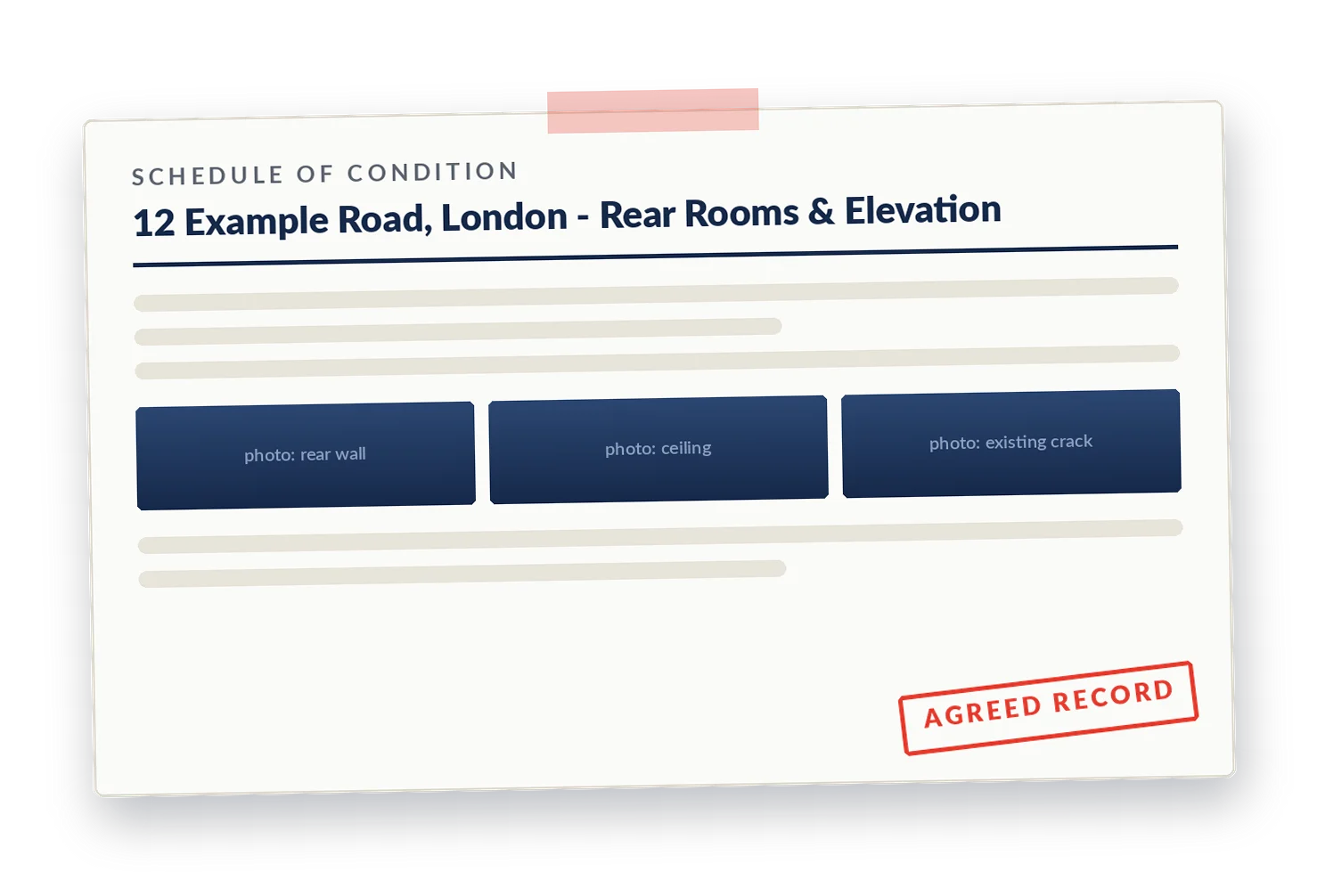
Both owners hold the same schedule of condition report, and that is what makes it fair. Neither side can later argue about what the property looked like before the works.
In most cases, yes, and the recommendation does not change with how your neighbour responds. The Act does not make it compulsory in every situation, but skipping it leaves both sides exposed.
If your neighbour dissents, the surveyors will almost always include one as part of the Party Wall Award. If your neighbour consents, it is still strongly recommended before works begin. Consent removes the Award, not the risk of a damage claim.
So if you are asking do I need a schedule of condition, the practical answer is simple. If the works are close enough to need a notice, they are close enough to justify the record.
The document is impartial, and that is the point. It protects each owner in a different way.
Protection from unfair claims. If a crack existed before the works, the schedule proves it. Claims for pre-existing damage fail quickly, and genuine ones are settled without argument.
Protection if damage happens. If the works cause a new crack, the schedule proves that too. There is no dispute about whether it was there before, so repairs are agreed faster.
The schedule of condition survey takes place after the notice is served and before the works begin. Where a Party Wall Award is being prepared, it usually happens alongside, so the works can start as soon as the Award is served.
The surveyor arranges access with the Adjoining Owner at a convenient time. The visit is short, and most homes take an hour or two.
As with the rest of the party wall process, the Building Owner usually pays. The cost is modest against the value of the works, and our guide on party wall surveyor costs covers what affects it.
LENIO Party Wall Surveyors records Schedules of Condition across London, for Building Owners and Adjoining Owners. Call or send your project details and a chartered surveyor will confirm what your project needs.
LENIO Party Wall Surveyors has 5+ years of party wall practice across London. A chartered surveyor leads every instruction personally. Dissents and Party Wall Awards are a routine part of the practice’s work. These range from single-surveyor appointments on straightforward extensions to two-surveyor disputes on basement and structural projects.
LENIO specialises entirely in party wall matters. Every guide on this site is written from direct professional experience of the process, not from secondary research.
No, the Act does not make it compulsory in every case. However, where surveyors prepare a Party Wall Award, they almost always include one, and most surveyors recommend one even where the neighbour consents.
Think of it as optional in law but essential in practice. It costs little, takes an hour or two, and removes the biggest source of argument after works.
For most London homes, the inspection itself takes one to two hours. The surveyor records the rooms and elevations closest to the works, not the whole property.
The written schedule of condition survey report usually follows within a few days. Both owners then hold the same agreed record before works begin.
The schedule of condition cost is usually modest compared with the rest of the party wall process. Where an Award is being prepared, it is often included within the wider surveyor’s fee rather than charged separately.
Lenio confirms what is included in the quote before any commitment is made. Our guide on party wall surveyor costs explains the wider figures.
The surveyor will explain that the record protects the neighbour most of all, and most owners then agree. Access for the survey itself cannot be forced where there is no Award in place.
If access is still refused, the surveyor records that fact and documents what can be seen externally. A refusal noted in writing still gives the Building Owner useful protection later.
No, and it is not meant to. A claim can still be made if damage happens. What the schedule does is make the claim quick and fair to resolve, in either direction.
New damage is repaired or compensated without argument. Pre-existing damage is identified just as quickly, and the claim ends there.
No. A structural or building survey assesses the condition and risks of a property for its owner or buyer, with professional opinion attached.
A Schedule of Condition records facts only, for both owners equally. It makes no recommendations and gives no valuation. It is evidence, not advice.
A chartered surveyor records every Schedule of Condition at LENIO Party Wall Surveyors personally. With 5+ years of party wall practice across London, LENIO provides free initial advice before any commitment is made.